
 As young parents, we made it a point to take our children to a dentist, ophthalmologist, and ENT every year. Not because anything seemed wrong. Just because it felt like the right thing to do.
This despite the fact that we had plenty of doctor friends and contacts — by virtue of heading the health-industry for a software MNC in India. If anyone had the connections to make this easier, it was me. And yet, every year, it involved straddling multiple appointments, waiting room delays, and reports across multiple files.
Taking all the reports and sitting with our paediatrician required careful documentation on our part. What we really wanted was for her to see my child holistically — not as a summation of separate clinical specialties, each with their own lens and their own file.
Also, there was a recurring twinge of guilt. It was commonly accepted that India had a shortage of specialists and more specifically paediatric sub-specialists. I knew the statistics — I had often cited them to make the case for digital transformation in healthcare. But here I was, bringing a healthy child to an already overworked specialist, while another child with a diagnosed problem waited outside.
Was I wasting everyone’s time? And yet I kept going. Because fuller context, I had always believed, leads to better clinical decisions.
When our daughter was 3, all of it paid off.
We had noticed she kept rubbing her eyes. We brought it up at the next consultation. The ophthalmologist told us she had astigmatism — and that most parents discover something like this only at 6 or 7, when children start school and begin struggling to read the board.
What followed was one of the most important pieces of medical knowledge we’ve ever received as parents: astigmatism is linked to the shape of the eyeball and cannot be immediately corrected. But discovering it early gives you a chance to correct vision using glasses — which trains the brain to recognize 20/20 vision. That window closes around age 6 or 7. Miss it, and even if you correct the eye power later, the brain has never been trained to process 20/20 vision. And so 20/20 vision is never truly achieved, if astigmatism goes undetected before the age of 6.
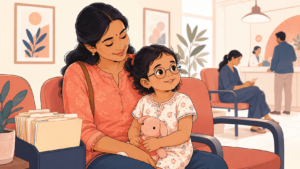
It broke our hearts the first time we saw our beautiful 3-year-old — with the loveliest eyes — in glasses. It made us emotional when the doctors recommended “patching” and she happily ran around with a patch on one eye like a little pirate.
But we also felt something I didn’t expect: immense gratitude. My exposure to the health industry had shaped our philosophy on child health. And we had caught this early enough to matter.
In the years that followed, I became familiar with India’s RBSK — the world’s largest child health screening program — and an AAP initiative called Bright Futures. I felt that what they represented was genuinely important. And that it would be enormously valuable to urban parents in India who had no equivalent.
That thought sowed the seed for Qavach®.
But other factors and experiences eventually shaped the decision to register as a not-for-profit, and to prioritize the 2-5 year age window specifically. That’s a story for another day — and one I look forward to sharing in future posts.
T.S.Y. Aravindakshan is the Founder & Director of Swastify Foundation.